
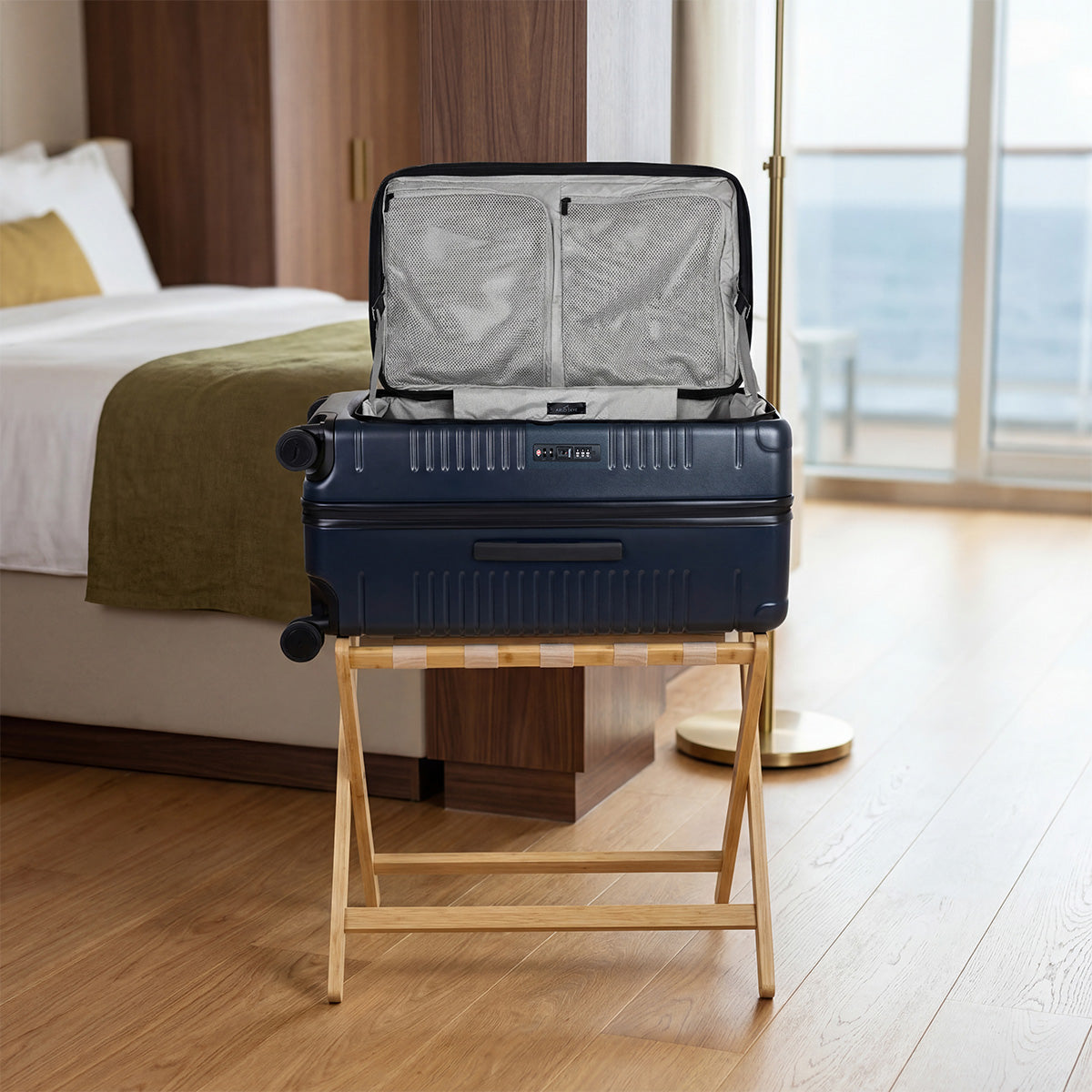
A cruise cabin has a way of revealing what actually matters in a suitcase.
In a hotel, luggage is often just a container: something you unzip, unpack, and ignore. On a cruise, it becomes part of the room. It slides under the bed if it can, waits beside a wall if it cannot, and often remains in active use far longer than most travelers expect. For a week or more, it is not simply carrying your things. It is living with you.
That changes the criteria.
Capacity still matters, of course. But on a cruise, the more interesting question is not how much a suitcase holds on paper. It is how gracefully it functions once it is inside a small stateroom with limited storage, narrow walkways, and very little room for inconvenience.
Here are six details worth thinking about before your next sailing.
1. Floor space matters as much as packing space
Most luggage is sold on capacity. On a cruise, exterior shape can be just as important.
Two checked bags may hold roughly the same volume and behave completely differently in a cabin. A wide clamshell tends to assert itself the moment it enters the room. A deeper, narrower case often sits more cleanly beside a bed or wall and asks less of the space around it.
In larger accommodations, that distinction can feel academic. In a standard stateroom, it rarely is. A suitcase that occupies less lateral space can make the room feel noticeably calmer and easier to move through, especially once two people and a week’s worth of belongings have settled in.
2. The way a suitcase opens shapes the rhythm of the trip
This is one of the least discussed, and most consequential, parts of cruise packing.
A traditional clamshell opens into two equal halves. In the right setting, that is perfectly functional. In a compact cabin, it can feel disproportionately disruptive. One side lands on the luggage rack, the other pushes outward, and suddenly a simple act like finding a sweater or changing for dinner requires negotiating around the bag itself.
A suitcase with single-lid or top-access entry often feels more composed in a small room. You open one side, reach in, take what you need, and close it again. The difference sounds minor until you repeat that motion several times a day for a week. Then it begins to feel less like a feature and more like relief.
3. On a cruise, your suitcase often becomes part dresser, part storage system
Cruise cabins do offer storage, but rarely enough to make your suitcase irrelevant. There may be a few drawers, a compact closet, and some shelving, though usually less than you imagine and always less than you would prefer.
So many travelers end up living partly out of their luggage, whether intentionally or not. Swimwear may stay in the case. Shoes often do. Layers for breezy evenings, formalwear, activewear, and the pieces you need but do not necessarily want to cram into a drawer all tend to remain in circulation.
That is why a cruise suitcase should be judged not only by how well it packs at home, but by how well it functions on day four. The best ones do not merely contain clothing. They support a routine.
4. Good separation becomes more valuable as the week goes on
Cruise travel creates more categories than people expect. Clean clothes. Worn clothes. Shoes from port. Damp swimwear. Evening pieces you would rather keep protected. Purchases made along the way. The challenge is not simply fitting everything in. It is keeping it from collapsing into disorder.
This is where thoughtful interior structure quietly earns its value. Packing cubes help, of course, but so does a bag that allows for intuitive stacking, easier access, and some degree of separation without forcing you to unpack half the case to reach the other half.
The longer the sailing, the more this matters. What feels neatly packed on embarkation day often turns untidy by midweek. A suitcase that can absorb that entropy gracefully is a better travel companion than one that only looks organized when photographed.
5. Cruise conditions are not quite the same as airport conditions
Most suitcases are tested, informally at least, in airports. Cruise travel introduces a slightly different set of demands.
Your bag may move across pavement, terminal floors, ramps, gangways, and long carpeted hallways before it even reaches the room. Once onboard, it may be maneuvered through narrower corridors and tighter corners than most hotel travel requires. Wheels that seem perfectly acceptable on polished airport tile can feel less impressive on thick carpet or under the weight of a fully packed checked case.
Materials matter differently, too. Cruise luggage is exposed to humidity, repeated handling, and the low-level wear of a bag that remains in active use rather than being unpacked and forgotten. A sturdy shell, smooth-rolling wheels, and an interior that holds up well in a more humid environment are not glamorous considerations, but they tend to be the ones travelers appreciate most once the trip is underway.
6. The return journey is usually less orderly than the departure
People tend to leave for a cruise with discipline and return with improvisation.
By the final evening, the original packing logic has often unraveled. Laundry has entered the equation. Souvenirs have appeared. Receipts, gifts, small purchases from port, and the general disarray of travel have all taken up residence. Even travelers who packed beautifully at home are often simply trying to get everything back in with minimal fuss.
A suitcase that allows a bit of flexibility, whether through expansion, easier repacking, or a shape that is simpler to work with under time pressure, becomes especially useful here. The goal is not perfection. It is avoiding the familiar last-night ritual of kneeling on a half-closed suitcase and wondering what went wrong.
The bottom line
The best luggage for a cruise is not necessarily the largest, the lightest, or the most feature-heavy. It is the piece that feels easiest to live with once the voyage begins.
That usually means a case with a disciplined footprint, straightforward access, strong internal organization, dependable wheels, and enough flexibility to handle the return trip without unnecessary drama.
It is also why trunk-style luggage has become more compelling for some cruise travelers. Not because it is novel, and not because it photographs well, but because in a compact cabin, a bag that opens more cleanly and occupies less of the room can make the entire experience feel more considered.